
KATRINA PENMAN: Composer & Flutist
Updated: Aug 29
We had the pleasure of speaking with British-born composer and flutist Katrina Penman (she/her) about her musical journey and the experiences shaping her creative practice. With her work performed across Europe, the Americas, and Australia, Katrina brings a unique perspective as both an instrumentalist and composer.
Read more about Katrina’s work, artistic journey, and inspirations below.
Katrina's Bio
British-born composer and flutist Katrina Penman studied at the Royal College of Music, London, and the Teatro alla Scala Academy, Milan. She subsequently performed in various operas and ballets at La Scala with Gustavo Dudamel, Riccardo Chailly and Daniel Harding. From 2007 to 2009, she toured with the Symphonica d’Italia under Lorin Maazel.
Katrina’s works have been performed worldwide, most recently at the Teatro Real in Madrid and at the US, Australian, Spanish, Colombian, Argentinian, Brazilian and Portuguese Flute Festivals, as well as in numerous universities and conservatories. Her 2026 Cantata, commissioned by the Orquesta Sinfónica de Castilla y León, was performed by 2,000 schoolchildren together with the professional symphony orchestra and soprano soloist.
In 2025, Katrina won Silver Medals (Composer and Instrumentalist) at the Global Music Awards for her album “Beyond”, comprised entirely of her original works for flute. This album recently won the Premios Latino category Composer-Performer of Classical Music and was nominated for Best Instrumental Album at the 2026 Spanish Music Academy Awards. Katrina was nominated for Composer of the Year at the Global Flute Awards of 2025. In 2019, she won a composition prize at the Galway International Flute Festival, where her music was premiered for Sir James Galway.
In 2026, Katrina completed a Master’s degree in Audiovisual composition at the Universidad Complutense de Madrid.
A CONVERSATION WITH KATRINA
Tell us about your artistic journey. What brought you to where you are today?

It's certainly all down to the excellent teaching and mentoring I have been lucky enough to receive during my life, and to my family for always supporting these activities. I am sure that my love for the flute came from my first teacher, Helen Duffy, who was always so kind to me (and to everyone!), encouraging and, most importantly, fun! I learned with Helen from age 8 to 18, and she also encouraged my interest in composition and in learning to play the piano. My high school teacher, Sheila Cornall, was instrumental in helping me get my compositions performed by student groups and in school concerts, and she put me in touch with Dr Timothy Bowers, composition professor at London's Royal Academy of Music, who agreed to give me private classes while I was still in school.
At conservatoire level, I focussed on the flute, with my wonderful professor Jaime Martín at London's Royal College of Music, who inspired me every day with his great passion for music, and I then went on to complete the postgraduate course at the Teatro alla Scala orchestral academy in Milan, which allowed me to perform alongside musicians at the very highest level and gain experience in the world of theatre (opera and ballet). Everything I learned along the way, from my teachers and colleagues, has shaped the musician I am today. Since beginning to work professionally in 2007, I have continued to grow and learn through every new experience, as well as through encouragement and opportunities for my compositions from colleagues both nationally and internationally. Another key moment for me was meeting and training with Portuguese maestro Paulo Lameiro, a musicologist specialized in education and communication, in 2013. The most important thing we can do as musicians on any artistic journey is to keep learning at every opportunity.
What has been one of the most meaningful or rewarding moments in your career so far?
In May 2026, we premiered, in Valladolid (Spain), where I live, an inclusive, participative Cantata that I was commissioned to write by the Castilla y León Symphony Orchestra (OSCyL) to celebrate 15 years of their educational and social project, "Miradas", with which I have been involved for the last ten years. It was incredibly moving and rewarding to work on this project, performed by around 2,000 schoolchildren across six performances, including children from under-resourced neighborhoods and special education schools. After the initial creation period, it was beautiful to watch the rehearsals evolve with teachers and students and to see everything come together in the final week, with the professional orchestra and soprano soloist Paula Mendoza, under the baton of Jhoanna Sierralta. This has definitely been the most rewarding experience of my career as a composer, seeing my music enjoyed by so many different people all together.
What are you currently working on, and what excites you about it?
I am currently working on a new chamber music piece commissioned by saxophonist Ismael Arroyo and pianist Eduardo Moreno as part of a December concert series for the INAEM (Spanish National Institute for Arts and Music). It will be exciting, as they are a fantastic young duo with great energy and strong musical expertise.
I am also working on the program for the Flute ensemble concert at the Spanish Flute Association (AFE) convention in April 2027, which Viviana Guzmán will conduct. This is very special because it's the first time we have run a flute ensemble at an AFE event, and we are hoping for maximum participation!

In addition, I will soon start work on the music for a new theatre show programmed for the end of next year, aimed at young audiences, which is always very enjoyable.
On the flute, I am studying repertoire by contemporary Spanish women composers, including two brand-new works written for me, which I will perform in international concerts beginning in February 2027.
In the near future, I look forward to the premiere of my String quartet, "Bajo el roble," commissioned by the ESAS Women's Creative and Artistic Network in the Basque Country, on 4th September in Guernica.
Who or what has had the greatest influence on you as an artist?
It probably started with my grandmother, who took me to the theatre in London when I was very small and introduced me to ballet, opera, and musicals. I just knew that was something that I wanted, in some way, to be involved in anything that had to do with live music.
As a flute player, my absolute favorite has always been James Galway, thanks to the cassettes my mother and family friends gave me. My mother then took me to see him in recital at the Barbican when I was a teenager, and I was then lucky enough to meet him several times during my studies in Italy, and to have my music performed for him at his festival in Weggis in 2019. One of Galway's most special qualities has always been his ability to communicate his love of music to the public, and I admire and strive to achieve that same ability.
What does your creative process look like? Where do your ideas come from?
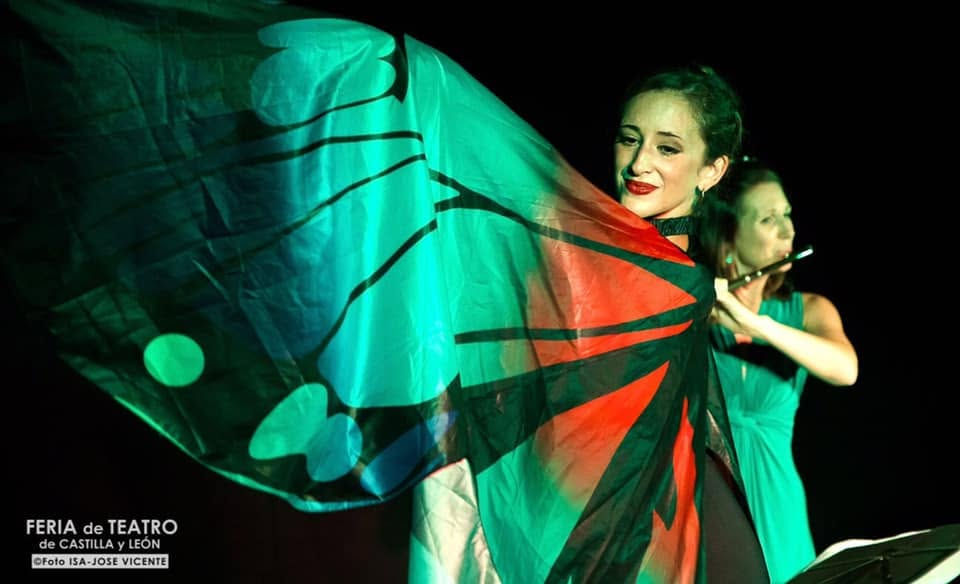
My musical ideas often come from extra-musical sources, such as legends, poems, or emotions, though they can also come from sound worlds like folklore. When an idea comes to me, I try it out on my instruments or by singing, write down the parts I like, and then develop them into a whole.
I often have two or three projects going at once, which lets me work on one for as long as I want, and if I need a break or get a little stuck, I can switch projects for a fresh approach.
What has been one of the biggest challenges you've faced in your artistic career, and what did you learn from it?
Being a mother, and then a single mother, has been both my greatest challenge and my greatest gift. It forces me to focus, to be super efficient, and to concentrate on what really matters, both in my work and in my family life. It has made me stronger and more compassionate toward others. Artistically, it opened new doors for me, including my interest in music for children and social projects, which has become an important part of my work since I began collaborating with the children's theatre company "Teloncillo" in 2014 and the "Miradas" social project in 2016.
It has also strengthened my inclination to collaborate with other women through organizations of professional female artists in my city and internationally, and to create works inspired by similar stories, such as my vocal monodrama, "Kintsugi" (2025).
What does collaboration mean to you, and what makes a collaboration successful?

In a collaboration, the human aspect is, for me, the most important. It is a joy to collaborate with other people, bringing together each person's strengths to achieve a better goal. On the other hand, if you have a group of talented artists but no empathy, the collaboration will likely not work out well. For me, success comes from trying to bring out the best in each other. We're lucky to collaborate internationally today through virtual messages and meetings; however, the real magic happens when we finally meet in person!
What do you hope your work contributes to the world?
If my work can bring a little more joy or empathy into the world, or help connect people through music and music-making, I'd be very happy.
Why do you think organizations like LunART are important in today's artistic and cultural climate? What role can they play in supporting the future of women and underrepresented artists?
This kind of organization is an essential way to support each other as women and underrepresented artists, providing opportunities for contact and the birth of new collaborations, as well as overcoming difficulties using shared knowledge or experiences, celebrating achievements together, and building stronger and more varied creative proposals drawing upon the combined strengths of individual members who, together, can enrich the artistic climate.
QUICK TAKES
A woman artist everyone should know: Rosalía
Your current artistic obsession: Learn and improve
Your creative superpower: According to the Pokémon card my youngest son made of me, it's "Hyper Flauta"!
A work of art you never get tired of: Un bel dì vedremo by Puccini
One word that describes your artistic philosophy: Express
Something you're looking forward to: Hearing new performances of my music
Follow Katrina:

Katrina Penman’s work as a composer and flutist shows how music can bring creativity and individuality to the stage. Artistic performances also inspire unique costume ideas, such as an adult Wybie costume.
I recently needed to calculate volume of a pyramid, and using an online calculator was much faster than repeating the entire calculation several times after adjusting the dimensions.
I played Block Blast while waiting for a neighborhood recycling truck to finish collecting the bins on my street. I heard the truck start moving again from the next block.
There are no complicated tutorials or lengthy instructions. You start jumping in Doodle Jump, learn how The Doodler moves, and gradually develop better timing through experience.